Giants in Stone: Egypt’s Colossi and the Question of Origins
- No Comments
Ancient Civilizations · Archaeology
Giants in Stone:
Egypt's Colossi and
the Question of Origins
A field inquiry into precision, scale, and what the stone remembers
By Cliff Dunning
70ft
Abu Simbel Face Height
1,000t
Ramesseum Colossus Weight
3500 BC
Earliest Dating
The First Encounter
I've spent years walking ancient sites, but nothing prepares you for standing at the base of Egypt's colossi. These are not simply large sculptures — they are overwhelming, deliberate, and strangely composed, as if scale itself has been engineered for effect.
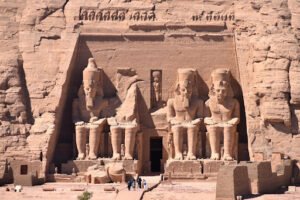
At Abu Simbel, the rising sun reveals faces carved directly into living rock — balanced, calm, and impossibly refined at nearly 70 feet high. There is no sense of excess. Every line appears measured. The symmetry holds even at distances where the human eye would normally lose precision.
"At Luxor, the experience shifts. The statues are not isolated — they're integrated. They frame space, guide movement, and lock into the architecture around them. You don't just look at them — you move through them."
Then there is the Ramesseum. There, scattered across the ground, lie the broken remains of a fallen giant — once approaching 1,000 tons. The fragments are not rough or crude. Even in ruin, they retain a level of refinement that suggests careful planning at every stage of execution.
"How were these made — and are we certain who made them?"
Power, Scale, and Intent
The traditional explanation is clear. Colossi were expressions of divine kingship — monuments to permanence, authority, and cosmic order. The pharaoh was both ruler and god, and scale was the visual language that reinforced that idea.
At Luxor and Karnak, this becomes architectural. The statues are not decoration. They are anchors — defining thresholds, reinforcing symmetry, and aligning with pylons, courtyards, and processional pathways. They function as part of a larger symbolic landscape.
But symbolism does not carve stone. And while the purpose of these statues is well understood, their execution remains less settled than we often assume. Because what stands out is not just size — it's precision at scale.
Carving the Impossible
We know the accepted toolkit:
- Dolerite pounding stones
- Copper chisels
- Sand abrasives
These tools are well documented. Experimental archaeology has demonstrated that they can shape hard stone, even granite. But there is a difference between possibility and consistency.
Standing before these colossi, several observations become difficult to dismiss:
Uniform surfaces — not just smooth, but uniformly controlled across massive areas
Facial precision — features that maintain proportion and symmetry at heights where measurement becomes increasingly complex
Intentional transitions — between planes that feel deliberate rather than corrected
A small statue allows for refinement through iteration. A colossus does not. Once material is removed, it cannot be replaced. Errors are magnified with scale.
This suggests something important: these figures were not gradually discovered through carving. They were preconceived in full. That level of execution implies a system capable of translating design into stone with minimal deviation — not just artistic skill, but engineering foresight.
The Problem of Scale
Modern sculptors understand the difficulty of scaling a model. Even with advanced tools, enlarging a figure while preserving proportion requires precise measurement systems — grids, reference points, and constant verification.
At that scale:
01
Small proportional errors become visually obvious
02
Vertical alignment must remain consistent across multiple working levels
03
The human eye alone becomes unreliable for judgment
"The methods used may have extended beyond simple visual scaling. There may have been practical techniques — now lost — that allowed for reliable enlargement and alignment at monumental scale. Not theoretical. Operational."
A Repeatable Language
Across Egypt, the pattern holds:
Proportion
Similar proportions maintained across different sites and eras
Placement
Consistent position within temple architecture and sacred geometry
Purpose
Repeated symbolic roles and orientations from Karnak to Abu Simbel
From Karnak to Luxor to Abu Simbel, the colossi follow a recognizable design logic. This is not isolated brilliance. It is repeatable. And repeatability implies transmission — knowledge that can be taught, applied, and replicated across generations.
"What if this knowledge did not originate in the periods to which the statues are currently attributed?"
The Attribution Problem
Most of Egypt's great colossi are associated with Ramesses II. His name is everywhere — on temples, statues, and monuments across the country. But Ramesses II is also known as one of Egypt's most active reusers of earlier works. He re-carved inscriptions. He appropriated statues. He inserted himself into existing monuments.
This was not unusual. It was part of maintaining continuity with the past. But it introduces a fundamental problem: if inscriptions can be altered, then attribution becomes less certain.
- Variations in finishing quality between different sections
- Evidence of reworking in facial features and inscriptions
- Differences in style suggesting more than one phase of execution
In some cases, the stone tells a more complex story than the cartouche.
Layers in Stone
Recent advances in scanning technology are beginning to reveal details that were previously invisible. 3D surface mapping and tool mark analysis allow researchers to detect subtle differences in carving technique — differences that can indicate multiple phases of work.
Initial rough shaping — the foundational cut
Secondary refinement using different techniques and possibly different hands
Later modifications, including re-inscription and facial reworking
"What we see today may not represent the original intention — but the final stage in a longer sequence."
The Possibility of a Lost Science
Consider what is required to produce these colossi consistently:
- Reliable methods for scaling designs to monumental size
- Techniques for achieving symmetry across vertical and horizontal axes
- Surface finishing processes that maintain uniformity across massive areas
- Organizational systems capable of coordinating large, skilled workforces
This is not just craftsmanship. It is applied knowledge. And when that knowledge appears fully formed, with limited evidence of incremental development, it raises a legitimate question:
"Was this knowledge accumulated gradually — or inherited from an earlier phase?"
We know that Egypt itself looked backward. The Egyptians preserved older traditions, reused earlier structures, and referenced a distant past they considered foundational. What if that past included technical knowledge that later generations maintained — but did not originate?
Standing Before the Giants
When you stand in front of these statues, the intellectual questions fade for a moment. What remains is the impression.
Not
Experimental
Not
Tentative
But
Confident
"They feel like the product of a tradition that knows exactly what it is doing. That confidence is difficult to ignore. It suggests familiarity — not discovery."
A Question Worth Asking
Egypt's colossi are among the greatest achievements in human history. That much is certain. But certainty ends there.
What we are seeing may not be the beginning of monumental stone carving in Egypt — but its continuation. Not the invention of a method — but the inheritance of one.
The timeline of knowledge may be longer — and more complex — than the timeline of kings.
They are not only monuments to power. They are monuments to understanding.
Topics
Archaeology
Bronze Age
Iron Age
Georgia
South Caucasus
Ancient Civilizations
Cyclopean Fortresses
Egypt
Colossi
Ramesses II
Latest Post
Tags
Archaeology
Bronze Age
Iron Age
Georgia
South Caucasus
Ancient Civilizations
Cyclopean Fortresses